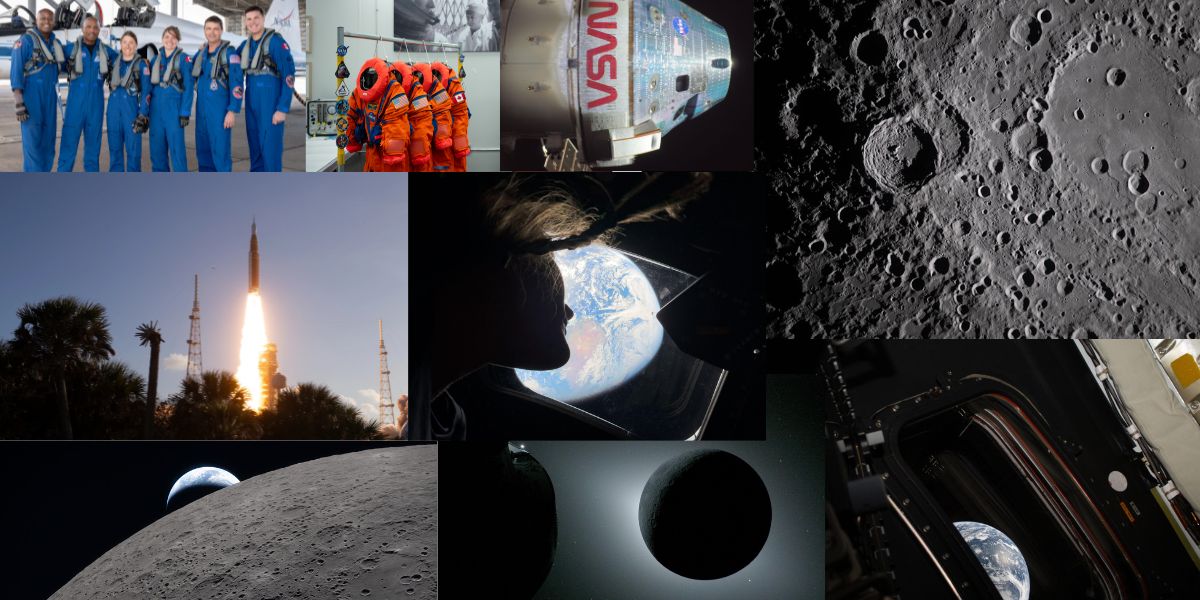
NASA’s Artemis II mission has marked humanity’s return to crewed deep space for the first time in more than 50 years, with the historic launch now documented in an extensive high‑definition image library.
From left to right, NASA astronauts Andre Douglas, Victor Glover, and Christina Koch, CSA (Canadian Space Agency) astronauts Jenni Gibbons, NASA astronaut Reid Wiseman, and CSA astronaut Jeremy Hansen pose for a photo before the Artemis II crew proceed to a media event on March 27, 2026. Douglas and Gibbons are the backup crew members for the mission; they would join the crew if a NASA or CSA astronaut, respectively, is unable to take part in the flight. Artemis II is NASA’s first crewed mission under the Artemis program and will launch from the agency’s Kennedy Space Center in Florida. It will send Wiseman, Glover, Koch, and Hansen on an approximately 10-day journey around the Moon. Among other objectives, the agency will test the Orion spacecraft’s life support systems for the first time with people and lay the groundwork for future crewed Artemis missions. Image credit: NASA/Josh ValcarcelThe Orion Crew Survival System suits that Commander Reid Wiseman, Pilot Victor Glover, and Mission Specialist Christina Koch from NASA, and Mission Specialist Jeremy Hansen from the CSA (Canadian Space Agency) will wear on the Artemis II test flight are seen in the suit-up room of the Neil A. Armstrong Operations and Checkout Building, Saturday, Jan. 17, 2026, at NASA’s Kennedy Space Center in Florida. NASA’s Artemis II test flight will take Wiseman, Glover, Koch, and Hansen around the Moon and back to Earth no later than April 2026. Photo Credit: (NASA/Joel Kowsky)
Article continues after this ad
Advertisement
The Space Launch System rocket lifted off from Launch Complex 39B at Kennedy Space Center on April 1, 2026, carrying four astronauts on a 10‑day journey around the Moon and back to Earth.
April 1, 2026. Astronauts Reid Wiseman, Victor Glover, and Christina Koch, and CSA (Canadian Space Agency) astronaut Jeremy on an approximately 10-day journey around the Moon and back aboard their Orion spacecraft. Image credit: NASA/Aubrey Gemignani
The resulting images showcase the raw power of the SLS rocket, dramatic plume formations, crowd reactions and rare perspectives unavailable during previous Moon missions.
Image Credit: NASA
Every phase of the launch was captured in crisp detail, from ignition and liftoff to tower clear and ascent, using a network of fixed, tracking, aerial and remote cameras positioned across the space centre.
Article continues after this ad
Advertisement
art002e004357 (April 3, 2026) – Orion snapped this high-resolution selfie in space with a camera mounted on one of its solar array wings during a routine external inspection of the spacecraft on the second day into the Artemis II mission. Image Credit: NASAA view of Earth taken by NASA astronaut and Artemis II commander Reid Wiseman from one of the Orion spacecraft’s four main windows after completing the translunar injection burn on April 2, 2026. Image Credit: NASAA close-up view taken by the Artemis II crew of Vavilov Crater on the rim of the older and larger Hertzsprung basin on Monday, April 6, 2026. The right portion of the image shows the transition from smooth material within an inner ring of mountains to more rugged terrain around the rim. Vavilov and other craters and their ejecta are accentuated by long shadows at the terminator, the boundary between lunar day and night. The image was captured with a handheld camera at a focal length of 400 mm, as the crew flew around the far side of the Moon. Credit: NASA(April 6, 2026) – Midway through their lunar observation period, the Artemis II crew members – Reid Wiseman, Victor Glover, Christina Koch, and Jeremy Hansen – pause to turn the camera around for a selfie inside the Orion spacecraft. Image Credit: NASA
Beyond launch day, the Artemis II image collection also includes in‑flight views of Earth, the Moon and the Orion spacecraft itself, offering a complete visual record of NASA’s first crewed Artemis mission.
Article continues after this ad
Advertisement
The Moon, backlit by the Sun during a solar eclipse, is photographed by NASA’s Orion spacecraft on Monday, April 6, 2026, during the Artemis II mission. Orion is visible in the foreground on the left. Earth is reflecting sunlight at the left edge of the Moon, which is slightly brighter than the rest of the disk. The bright spot visible just below the Moon’s bottom right edge is Saturn. Beyond that, the bright spot at the right edge of the image is Mars. Credit: NASAThe lunar surface fills the frame in sharp detail, as seen during NASA’s Artemis II lunar flyby, while a distant Earth sets in the background. This image was captured at 6:41 p.m. EDT, on April 6, 2026, just three minutes before the Orion spacecraft and its crew went behind the Moon and lost contact with Earth for 40 minutes before emerging on the other side. In this image, the dark portion of Earth is experiencing nighttime, while on its day side, swirling clouds are visible over the Australia and Oceania region. In the foreground, Ohm crater shows terraced edges and a relatively flat floor marked by central peaks — formed when the surface rebounded upward during the impact that created the crater. Credit: NASA
All official imagery is available through NASA’s public media library, with assets cleared for editorial use across digital, broadcast and social platforms.